Showing posts with label On the Mall in DC. Show all posts

Monday, July 21, 2014

Martin Luther King, Jr. Memorial

The most recent addition to the monuments on the Mall is the Martin Luther King Jr. Memorial. It is the most substantial memorial to a non-President and African-American on the Mall in Washington. Dr. King was the most significant figure in America’s Civil Rights movement of the 1950’s and 60’s and may have written and delivered the most historically significant and well-known public speech of the 20th century. He was the youngest winner of the Nobel Peace Prize in 1964 and a U.S. federal holiday was established in his name in 1986.
Martin Luther King Memorial, DC
The monument sits on the Tidal Basin which is the small lake just to the south of the Mall. The statue of King faces the Jefferson Memorial and its back faces the Lincoln Memorial. Cherry trees had to be moved to accommodate the memorial, which are in bloom yearly around the date of Dr. King’s assassination on April 4. The King statue is not looking directly at the Jefferson Memorial, but his folded arms and serious facial expression seem be saying to Jefferson “You said all men are created equal, didn’t you?’

What visitors see when they come to the monument depends on the direction one comes from. Coming from the Lincoln Memorial on foot one sees white “mountains” and walks between them. When coming from the Smithsonian Metro, or from around the Jefferson Memorial side of the Tidal Basin visitors will see the thirty foot King statue and the inscription walls with fourteen quotes by King and “mountain” sculptures behind and on each side of the statue.

King’s head and torso, clad in a business suit, are clearly defined, while his legs appear to be coming out of the stone.  His facial expression is serious, his arms are folded and he holds a rolled up piece of paper in his left hand.

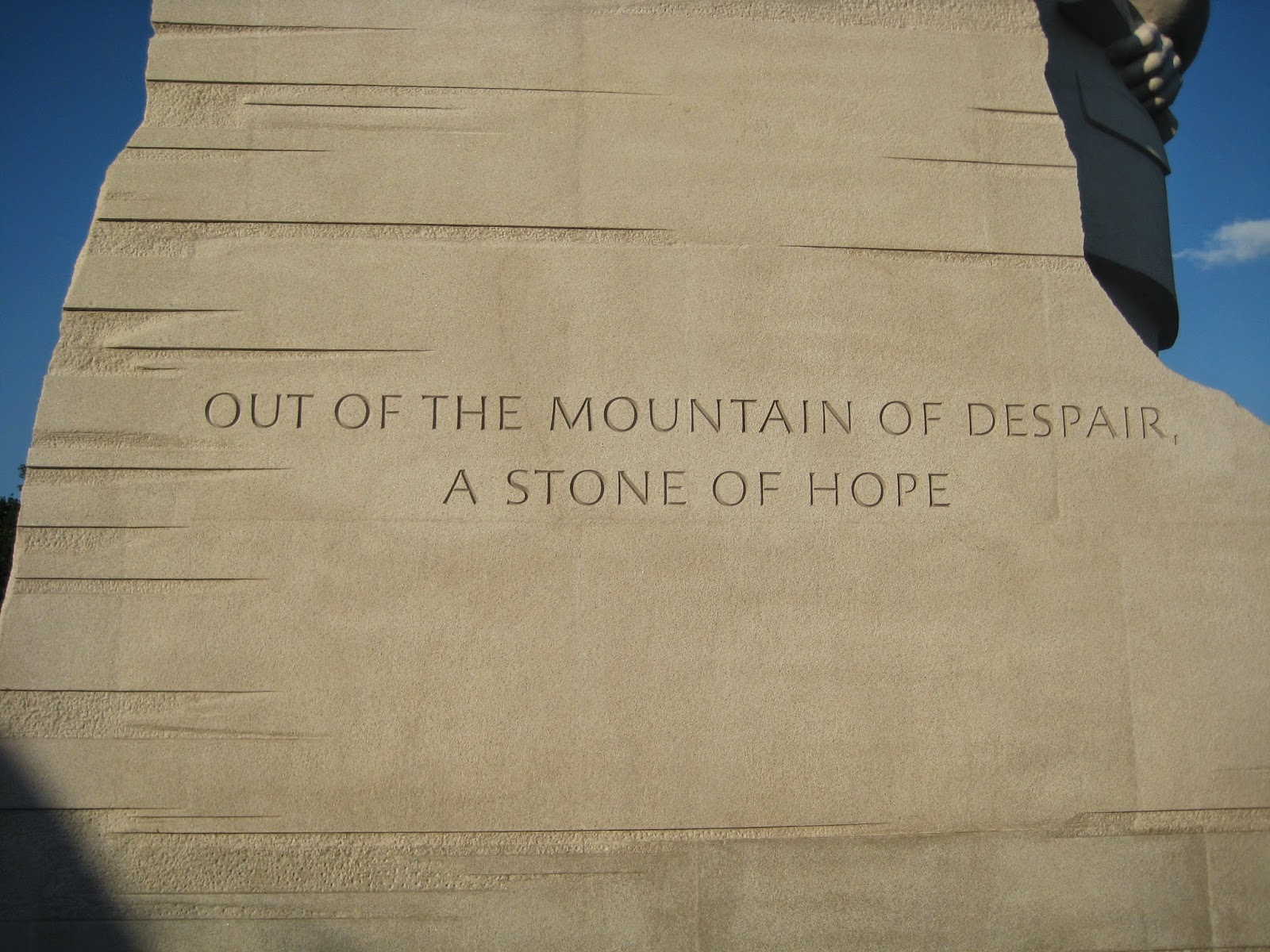
The idea for the memorial comes from the “I Have a Dream” speech. One of the quotes from the speech is “Out of the mountain of despair, a stone of hope.” That quote is etched on to one side of the King sculpture. On the other side was another quote, “I was a drum major for justice, peace and righteousness” It was determined that since the quote was inaccurate, it was removed in August of 2013. There are no plans to replace it.

The Wikipedia page for the Memorial has an overview of the various controversies surrounding the monument’s creation. This article from The Atlantic in 2013 addresses some the artistic and design criticism.

The inspiration to create the memorial came from the efforts of the Alpha Phi Alpha fraternity to erect a monument to King. He had been a member while he was attending Boston University. The design by ROMA Design Group, based in San Francisco was selected out of 900 candidates and they chose the Chines sculptor Lei Yixin. The two “mountains” and one “stone” are actually made up of 159 distinct pieces of granite that were carved in China, shipped to DC and then put together on the Mall.

The monument was dedicated on October 16, 2011, which included a keynote speech by President Obama.

Links: Official Site of the Martin Luther King, Jr. Memorial
          Wikipedia page for the memorial
          The Atlantic article
          You Tube clip about the memorial

Tuesday, June 10, 2014

Vietnam Veterans Memorial

It’s hard to imagine that as beloved as the Vietnam Veterans Memorial is now, that it was once referred to by critics as “the black gash of shame”. Just to the northeast of the Lincoln Memorial, it is very different from war memorials created in earlier times. One writer has recently called it “the most controversial and brilliantly successful works of public art in American history”, and many agree.

Vietnam Veteran's Memorial
The 58,000 plus names of those who died or remain missing from the Vietnam War, without rank or unit designation are all inscribed on 140 black granite panels. The panels start out very short on the ends and are ten feet tall at the center as the walkway in front of the panels descends below ground. The two sets of panels form a large “v” shape and the highly polished black granite reflects the images of the visitors, looking at the names.

The names are arranged chronologically based on their date of death. The earliest deaths from 1959 are recorded at the top of the center-east panel go to the last east panel and then start again at the far west panel and ending at the top of the center-west panel with names from 1975. The overall effect that the Wall creates is deeply moving, even healing for many who visit.

Mementos, letters, flowers and other items are left along the base of the Wall and all the non-organic material is collected and stored by the National Park Service. There are podiums nearby with printed directories for locating names on the numbered panels of the wall.  And visitors can take impressions of the names by pressing a piece of paper over the name and rubbing it with a pencil.

Not far away is a bronze statue, created by Frederick Hart named The Three Soldiers, depicting a White, Black and Hispanic American male soldiers. Nearby the sculpture is a memorial plaque honoring those “who served in the Vietnam War and died later as a result of their service” and just to the east, is another bronze sculpture, The Vietnam Women’s Memorial, designed by Glenna Goodacre, depicting three uniformed women with a wounded soldier.  

The inspiration for the memorial came from Jan Scruggs who had served as an infantryman and was wounded during the Vietnam War. He eventually raised over $8 million to build the memorial. Because the war had been so politically divisive his idea was to create a memorial that would focus on warriors and would be apolitical. A design competition was held that set four major criteria that included that it contain all the names of the dead and missing from the war.

Over 1400 entries had been submitted by the deadline in 1981 and the winner was Maya Lin, a 21-year-old Yale University architecture student. As news of the design got out, there was a great deal of criticism that it was too abstract and reflected no heroism on the part of the soldiers in the war. To satisfy the criticism, before the Wall was completed, it was decided to add the realistic sculpture of three soldiers and a flag.

The Vietnam Veteran's Memorial Fund is now planning to create an educational center with information about the war and the names on the wall. It will be built underground to preserve the landscape of the area near the memorial.


Sunday, May 11, 2014

National Museum of American History

When entering the National Museum of American History from the Constitution Avenue side, visitors might get the idea that the museum is all about transportation. The first thing everyone sees is a 19th century Conestoga wagon and just beyond that a newly installed silver-blue 1965 Ford Mustang. It’s there to commemorate the opening of the museum fifty years ago.  There is a lot of transportation history featured in the museum but lots of other objects as well.

National Museum of American History
And by walking to the East Wing on the first floor visitors will see the 1831 John Bull Locomotive and beyond it lots of cars, trucks, buses and trains. Included among them is the 1903 Winton which was the first car to be driven completely across the United States in the same year.  The trip took H. Nelson Jackson and his hired mechanic Sewall Crocker 64 days.

On the Water: Stories from Maritime America is nearby with lots of artifacts and models relating to America’s commercial boating history. And nearby these two exhibits, you’ll have to take a look at Food: Transforming the American Table, 1950-2000 which includes the kitchen from Julia Child’s Cambridge Massachusetts home. One of the other exhibits on the first floor, Lighting a Revolution, has an 1879 Edison Light Bulb that the inventor used in his first public demonstration of his brilliant idea.

The second floor has the real highlight of the museum and an item from Hollywood that runs a close second. The Star Spangled Banner is the flag that the soldiers raised over Ft. McHenry in September of 1814 after defeating the British attack on Baltimore that inspired Francis Scott Key to write the poem that would become the U.S. national anthem. The 30 by 30 foot flag is displayed in a darkened room to protect it from further deterioration.  Displays and materials in the exhibit helps explain conservation efforts and some of the history of the flag and the anthem.

The next galley over has the second item, a pair of women’s shoes covered in red sparkles, yes, those ruby slippers. They are at the entrance to the American Stories exhibit that has special items from the course of U.S. history, including a piece of Plymouth Rock and a Miss Piggy (1974), yes, her. And across the hall is an exhibit organized by the future National Museum of African American History and Culture, Changing America: The Emancipation Proclamation, 1863 and the March on Washington, 1963. Lincoln’s top hat that he was wearing the night he was killed at Ford’s Theater is currently a part of that exhibit.

The third floor has the First Ladies, The American Presidency, Gunboat Philadelphia and The Price of Freedom, which has artifacts from the two hundred plus years of U.S. military history. Some of the highlights include George Washington’s uniform from 1789, the furniture from the McLean House in Appomattox, Virginia when Lee surrendered to Grant, and an actual 1965 Huey Helicopter that was used in the Vietnam War.

Michelle Obama’s Inaugural Gown from 2013 is currently on view in the First Ladies exhibit and U.S. Grant’s carriage and Thomas Jefferson’s portable desk from 1776, yes used for writing that document, is at the center of The American Presidency section.

In many sections of the museums are small carts with hands-on materials that help keep younger visitors engaged in understanding the story of our nation's past.

The lower level has a large cafeteria and section with ride simulators, for those that want to actual feel some movement after looking at the transportation artifacts upstairs. Visitors will note that the west wing of the building is under renovation, and new exhibit halls and facilities will open in the coming years. The website for the museum is here and their You Tube channel is here.


Sunday, May 4, 2014

National Museum of Natural History

My kids are grown, but without question, if you have kids with you when you are visiting the National Mall in DC, you will pretty much have to visit the Smithsonian’s Natural Museum of Natural History.

National Museum of Natural History
But even if you don’t have kids and are interested in a scientific spin on the natural world, or just want to be awed, this is the place to see. Provided of course, you can handle big crowds. By one company’s count, D.C.’s Natural History Museum was the second most visited museum in the world in 2012.  

The museum has undergone a lot of transformation in recent years, but one artifact that is unchanged is everybody’s favorite meet-up place at the huge 8 ton 14 foot African elephant in the Rotunda.  And the transformation continues with the renovation of the National Fossil Hall (dinosaur exhibits) until 2019. But just because it’s closed shouldn’t discourage anyone, because there are plenty of things to do and see for both young and old.

For some kids and adults, the Live Insect Zoo on the second floor is a great place to start with display cases of lots of live insects. Also check at the desk or online to see when the daily tarantula feeding will take place. You might get to see the insect petting zoo where museum volunteers bring out a number of jars with various insects, some of which can be held.  And just around the corner is the Butterfly Pavilion. For extra charge visitors can enter a warm damp environment filled with flowering plants and lots of butterflies flying around. Tickets can be purchased in the same area.

Staying on the second floor is a small section about ancient Egypt, including a mummified cat and then a larger gallery of bones, skeletons of many different kinds of modern animals. On the other side of the Rotunda is the Hope Diamond and Dom Pedro Aquamarine, the world’s largest cut aquamarine gem, standing 14 inches tall and 4 inches wide. Beyond it are the Gems and Minerals and Geology displays. There is also a section displaying Korean art and artifacts and several sections for temporary displays.  Two of the current exhibits are on the genome and Asian Indians in America called “Beyond Bollywood”.

Then going downstairs is the impressive Mammal Hall, the Ocean Hall and the Hall of Human Origins. On weekends there are guided tours of the Ocean and Human Origins Halls. There is still a replica of a whale hanging from the ceiling in the Ocean Hall, and the giant squid in case in the middle is pretty impressive. There are also some very ancient marine fossils nearby.

Just across from the Mammal Hall is the new Rex Room where visitors can see the museum staff work on the bones of the new T. Rex until they are shipped off for reassembly in October of 2014.

There are also two Q?rius areas of interactive exploration. One smaller one for kids nine and under and the larger one for tweens and teens. They both have some interesting hands-on activities for young scientists. And then there’s the ginormous IMAX theater, the cafeteria and several gift shops.  Plan on at least half a day if not longer. The official website for the museum is here and they have their own YouTube channel here.

Links: Official website National Museum of Natural History
          You Tube channel for the National Museum of Natural History

Monday, November 25, 2013

Lincoln Memorial

The Lincoln Memorial, the national monument to honor America’s 16th president, is located near the Vietnam and Korean Veterans Memorials at the west end of the National Mall. Designed by New York architect, Henry Bacon, the memorial is based on the design of a Greek temple with 36 Doric columns, representing all the states, North and South, at the time of Lincoln’s death.  All 48 state names that made up the country when the memorial was completed in 1922, are inscribed around the top of the outside of the memorial and a plaque was added later recognizing Alaska and Hawaii.

Lincoln Memorial, Washington D.C.
Up a long set of steps and inside the chamber is the impressive nineteen-foot realistic sculpture of the sitting President Lincoln. When facing the Lincoln statue, on the right wall Lincoln’s Second Inaugural Address is inscribed, and on the left, the Gettysburg Address. Above the inscriptions on each side are murals painted by Jules Guerin representing emancipation and reunification. When facing out towards the mall from the chamber, on the left there is a small bookstore through a door off the chamber. On the other side is an elevator that goes down to the plaza level and opens into a small exhibit area with photographs and information about the construction of the memorial and some of the demonstrations that have been held at the memorial over the years.

The architect, Bacon befitting the idea of national unity, used a variety of stones in the construction. Massachusetts granite, Colorado marble, Tennessee pink marble, Indiana limestone, and Alabama marble were all used in different parts of the memorial The Lincoln statue itself is made of 28 pieces of Georgia marble.

An African-American, Robert Moton, gave the key-note address to the segregated attendees at the dedication of in 1922, but it would take an event in 1939 to make the memorial a focal point for civil rights demonstrations in Washington D.C. A proposal had been made for the well-known African-American singer Marian Anderson to perform at the DAR Constitution Hall in Washington. The Daughters of the American Revolution would not allow the performance because of her race. Eleanor Roosevelt, with the help of her husband, the President, arranged for her to perform on Easter Sunday morning at the Lincoln Memorial where some 75,000 people attended. Then in 1963, the memorial’s most famous event occurred when Martin Luther King gave his “I Have a Dream” speech at the March on Washington. The spot where King stood on the steps of the memorial is engraved. It could be argued that the Lincoln Memorial commemorates the two most important speeches in American history, The Gettysburg Address of 1863 and Martin Luther King’s speech of 1963. President Obama spoke at the memorial on the 50th anniversary of the King speech.


Two of the most discussed urban legends regarding the monument are that the Robert E. Lee can be seen in the hair on the back of Lincoln’s head (not likely) and that Lincoln’s hands are making the shape of his initials “A” and “L” in sign language.  There might be something to this idea, the sculpture, Daniel Chester French, had a deaf son, and Lincoln had signed the bill authorizing Gallaudet University, created to educate deaf students, to grant college degrees. There memorial is open 24 hours a day, park rangers are on duty until midnight and there is no fee for visitors.


Thursday, October 31, 2013

National Gallery of Art

Washington DC’s National Gallery of Art has to be considered one of the world’s great art museum. In The Art Newspaper’s survey it ranked 8th in terms of the most visited art museum in the world in 2012. In 1937 industrialist and art collector Andrew W. Mellon gave some 150 works of art valued at $40 million and $10 million in cash to create a national art museum to the U.S government. The collection now has more than 130,000 works of Western art from the middle ages up to the present.

National Gallery of Art, West Building
The museum is composed of two buildings connected by an underground concourse and an outdoor sculpture garden. The original (West) building was opened to the public in 1941. The East Building, designed by I.M. Pei and opened in 1978, is considered one of the great works of modern architecture in the U.S. I will write about it and the sculpture garden in other posts to this blog.

The collection is particularly rich in Italian, Dutch and French impressionist paintings and American, British, Flemish, Spanish, and German paintings are well represented. In 2012 there was a new permanent installation of 18th and early 19th century American furniture in the West Building. The website here, shows 45 works as the highlights of the museum’s collection and there are also three Less than an Hour? guides for the paintings in each building and the sculpture collection. The audio guide with the Director’s Tour, which is free, has commentary on over 130 pieces. There is also a Your Art mobile app for iPhone and iPod Touch available for free in the iTunes App Store. 

On my recent visit I decided to make my own top ten list. This is obviously subjective, but it is a nice representative list of Western art history all-stars. The works are listed in chronological order. All are paintings except for the Degas which is a sculpture.

The Annunciation, Jan van Eyck, c.1434/1436
Ginevra de’Benci, Leonardo da Vinci, c. 1474/1478
The Alba Madonna, Raphael, c. 1510
Venus with a Mirror, Titian, c. 1555
Self-Portrait, Rembrandt van Rijn, 1659
The Little Dancer Aged Fourteen, Edgar Degas, 1871-1881 (bronze sculpture)
Boy in a Red Waistcoat, Paul Cezanne, 1888-1890
Self-Portrait, Vincent van Gogh, 1889
Family of Saltimbanques, Pablo Picasso, 1905
Number 1, 1950 (Lavender Mist), Jackson Pollock, American, 1950

You’ll note that this list includes the only painting by Leonardo da Vinci on permanent display anywhere in North or South America.

The most important 18th century American work in the collection is Copley’s Watson and the Shark. Another significant American work currently on display is the full-sized plaster cast of Augustus Saint-Gaudens’ Robert Gould Shaw and the Massachusetts Fifty-Fourth, considered by some to be the most important American sculptural work of the 19th century. It commemorates the African-American soldiers of that regiment that served in the Civil War and their white commanding officer who was killed in the Battle of Fort Wagner in South Carolina.

There are several options for food and shopping and the cafeteria and one of the gift shops are in the Concourse which runs underground between the East and West buildings. Across from the cafeteria is a cascading waterfall in front of a large plate glass window and which then leads an artistic installation called the Multiverse, a complex light sculpture by the artist Leo Villareal that runs 200 feet along the length of the two moving sidewalks that connect the buildings. Visitors should note that the East Building will be closed for renovations for three years starting in December of 2013, although the atrium will remain open much of the modern art collection will not be on view. Some of the paintings from the modern art collection have been moved to several of the ground floor galleries at the west end of the West Building.

Wednesday, October 23, 2013

National Air and Space Museum

According to the people that track these things, the National Air and Space Museum in Washington D.C. was the third most visited museum in the world in 2012 after the Louvre and the Smithsonian’s National Museum of Natural History. When I went on one of the docent tours, the guide pointed out that sometimes during the busy season the museum is so crowded it’s hard to move around. It has to be considered one of the must-see places to see in DC.

National Air and Space Museum, Washington DC
Walking into the museum from the Mall side, the grand hall is impressive. It’s a huge room with aircraft hanging from the ceiling, spacecraft spread out around the floor and several tall rockets on one side wall. It’s called the Milestones of Flight exhibit and has many important historic airplanes and spacecraft.

On the floor level are the Mercury Friendship 7, John Glenn’s capsule, Gemini IV, from which Edward White II took the first American spacewalk and the Apollo 11 Command Module Columbia that carried Armstrong, Aldrin and Collins on their voyage to the moon in 1969. There’s also a piece of moon rock that visitors are encouraged to touch that came from the Apollo 17 mission in 1972.  Hanging from the ceiling are the first plane to fly faster than the speed of sound, the Bell X-1, the North American X-15 and Charles Lindbergh’s Spirit of St. Louis. There is some recognition of the Soviet Union’s early accomplishments in space flight; a replica of the Sputnik I hangs almost in the middle of the large atrium. Along the wall are two Cold War artifacts, a Soviet SS-20 and Pershing-II missile.

From a historical point of view the museums most important holding is probably the 1903 Wright Flyer, “the first heavier-than-air, powered aircraft to make a sustained controlled flight with a pilot aboard.” There’s an exhibit area with the plane and reproductions of the kite and gliders the Wright’s built to help them study the principals of flight that would lead to their remarkable invention.  Nearby is the Barron Hilton Pioneers of Flight Gallery that has the first planes to complete a transcontinental flight, an around the world flight and the bright red Lockheed 5B Vega that Amelia Earhart flew solo across the Atlantic in 1932.

At one end of the museum is an exhibit of six military unmanned aerial vehicles (UAVs) built during the last twenty years that point to one area of aviation that will likely see lots of future development. And for sci-fi fans, in the back of the lower level of the gift shop is the 11 foot model of the starship Enterpise used in filming the original Star Trek television series. 

There are twenty-one exhibit galleries, including ones on space travel, the planets, the world wars, sea-air operations, commercial aviation and much more, so if you wanted to really take it all in, you could easily spend a whole day in the museum. There’s a large food court and one end, a planetarium, IMAX theater, simulator rides and a large gift shop. So there’s lots to see and do for everyone in the family, including kids.

The companion museum in Northern Virginia called the Steven F. Udvar-Hazy opened in 2003 and it’s bigger than the DC location.